
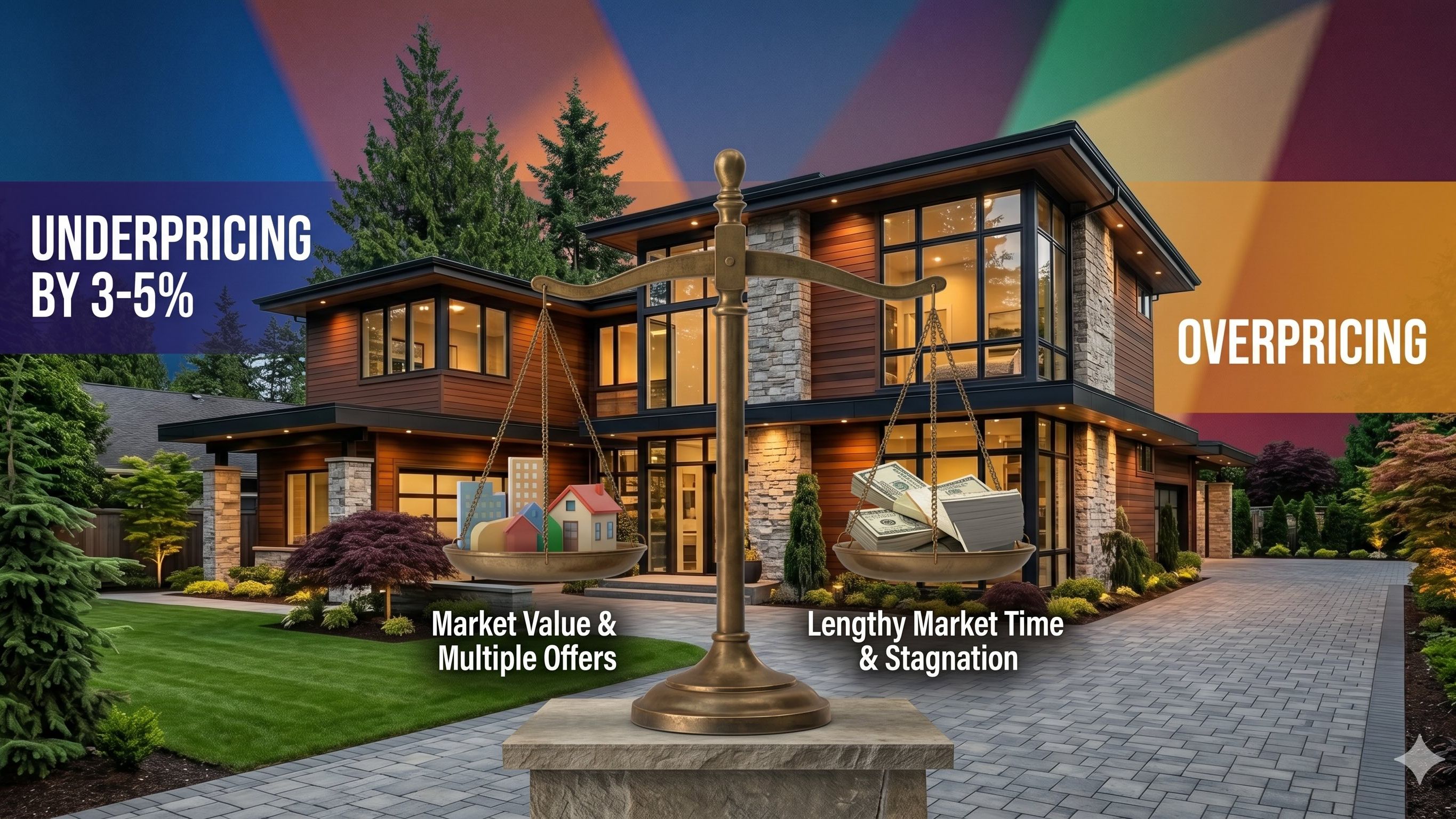
Can you underprice a home?
Jun 13, 2026
In the high-stakes world of West Bellevue real estate, pricing is never just a number. It is positioning. It is psychology. And in many cases, it is the difference between creating competitive tension and watching a luxury listing drift into the danger zone of extended market time.
So let’s start with the question sellers quietly ask all the time: Can you underprice a home?
The sophisticated answer is yes, but only if you understand what a list price actually is. A listing price is not a contract. It is not a promise to sell. It is an invitation to the market to respond.
That distinction matters more than most people realize, especially in the luxury segment, where buyer behavior is more strategic, inventory is more nuanced, and the wrong pricing move can cost a seller hundreds of thousands of dollars.
The Buyer Pool Problem: At $3M+, You’re Not Marketing to Everyone
In a typical housing segment, sellers can afford to think in broad strokes. In West Bellevue luxury, that approach falls apart quickly.
Homes priced at $3 million and above account for just 1.9% of total existing home sales nationally. That means the buyer pool is not just smaller; it is dramatically smaller. At this level, you are not casting a wide net. You are inviting a very specific room of buyers, many of whom are sophisticated, analytical, and highly sensitive to perceived value (especially in tech-heavy Bellevue).
That is why overpricing can be so dangerous in the upper tier. When the pool is already limited, even a modest pricing mistake can eliminate a meaningful percentage of your likely buyers. A well-calibrated list price, by contrast, creates engagement. It pulls qualified buyers into the conversation and gives the market room to compete.

In other words, underpricing is not about selling short. It is about widening participation in a narrow segment and letting demand reveal itself.
The Invitation Principle: A List Price Is Not a Contract
One of the biggest misconceptions in residential real estate is that if a seller receives a full-price offer, the seller must accept it. Under Washington practice, that is simply not how it works.
A list price is best understood as an invitation to submit an offer. The seller is not legally obligated to accept a full-price offer merely because it matches the published price. The seller can accept, reject, counter, or simply decide the terms are not right.
This is where experience matters. In 23 years of advising clients through Bellevue-area transactions and more than half a billion dollars in sales, I have seen this misunderstanding create unnecessary fear for sellers who would otherwise benefit from a more strategic pricing approach.
Pricing low does not mean surrendering control. It often means gaining leverage.
NWMLS Form 1A, Section 4: What Sellers Should Actually Know
There is, however, an important legal and contractual nuance that deserves clarity.
Under NWMLS Form 1A, Section 4, the seller’s agreement with the listing firm addresses commission obligations in the event the broker produces a ready, willing, and able buyer on the terms authorized in the listing agreement. That is a commission issue between seller and brokerage. It is not the same thing as forcing a seller to transfer title just because an offer came in at list price.
That distinction is critical.
A seller may still choose not to accept an offer. But depending on the exact facts, the listing agreement may create a commission obligation if the broker performed under the contract by procuring a buyer who met the agreed terms. This is why sophisticated pricing strategy should always be paired with careful review of the listing agreement, offer terms, and negotiation objectives.
In practical terms, the takeaway is simple: list price is an invitation to the market, while Form 1A governs the broker-seller relationship. They are related, but they are not the same thing.
The Stale Listing Penalty: Time Erodes Leverage
If underpricing is one side of the equation, overpricing is the other, and the data on that side is unforgiving.
Luxury properties that linger beyond 90 days on market often experience what I call the Stale Listing Penalty. Once a home passes that threshold, it commonly trades at a discount of 13% below the original list price. At that point, the issue is no longer visibility. It is narrative.
Buyers begin to assume something is wrong. The home loses its freshness. Negotiating leverage shifts away from the seller. Even strong properties can suffer because the market interprets extended time on market as a signal.

This is especially true in West Bellevue, where discerning buyers have options and tend to watch pricing dynamics closely. The first weeks on market are when a listing has energy. That early window is when sellers have the best chance to create urgency, attract multiple interested parties, and preserve negotiating power.
Strategic Pricing Requires Local Precision
None of this means every home should be priced aggressively below market. It means pricing should be deliberate, informed, and tailored to the property, the timing, and the likely buyer set.
Generic valuation logic does not work well for waterfront estates, architecturally significant homes, or tightly held enclaves like Medina, Clyde Hill, and Yarrow Point. These are not commodity assets. They trade based on scarcity, story, presentation, and the composition of the active buyer pool at that exact moment.
I bring that perspective from more than two decades in this market, with a practice built around precision, data, and local intelligence. Knowing the likely buyers, the competing inventory, the recent negotiation patterns, and the micro-market mood is what allows us to price with confidence rather than guesswork.
My Strategy by the Numbers:
- 23 Years of Experience: Long enough to see multiple market cycles and know the difference between noise and meaningful market indicators.
- Over Half a Billion in Sales: Transactional depth that informs pricing strategy, negotiation structure, and risk management.
- 102% Average Sale Price to ORIGINAL List Price Ratio (Since 2014!): A reflection of disciplined positioning, not luck.
- 21 Days Average Time on Market: Evidence that strategic pricing creates momentum.
- Over 470 Homes Sold: A track record built in one of the most competitive and nuanced luxury markets in the region.
The Real Question Isn’t “Can You Underprice?”
The real question is whether your pricing strategy creates competition or kills it.
In West Bellevue luxury, the best outcomes rarely come from chasing a hopeful number detached from buyer behavior. They come from understanding that list price is a market signal, not a contractual trap. When used correctly, it becomes an invitation that draws the right buyers in, creates urgency, and protects your leverage before time starts working against you.
If you are considering a sale and want to make an informed decision about pricing, positioning, and timing, I would be glad to help. The goal is not simply to put a number on your home. The goal is to create the conditions for the market to deliver its strongest response.
Your trusted partner,
Nate Short
Realtor | Coldwell Banker Bain, Bellevue
What Our Clients Say:
"Nate’s approach to pricing was completely counter-intuitive to us at first, but the results spoke for themselves. We had 8 offers in five days and sold for $2.15M over our list price! He truly knows the Bellevue market inside and out." : The G. Family, Bellevue